Cultura y noticias hispanas del Valle del Hudson
A Diego Rivera in Poughkeepsie
And Other Gems of Latin American Art at a Free Museum
Por Cesar Castro
April 2026Living in the Hudson Valley, you might assume that to see an original Diego Rivera or a Joan Miró, you have to travel to New York City, deal with traffic, and pay for expensive tickets to the big metropolitan museums. But the reality is that we have an experience of that caliber much closer to home. On the campus of Vassar College is the Frances Lehman Loeb Art Center, a local “secret” designed by Argentine architect César Pelli that offers an atmosphere of intimacy and discovery unique to our region.
The Loeb Center functions as a classroom without borders where art history is studied and appreciated by students, faculty, and locals alike. As you walk through the gallery rooms, you encounter a strong Hispanic presence on the walls.
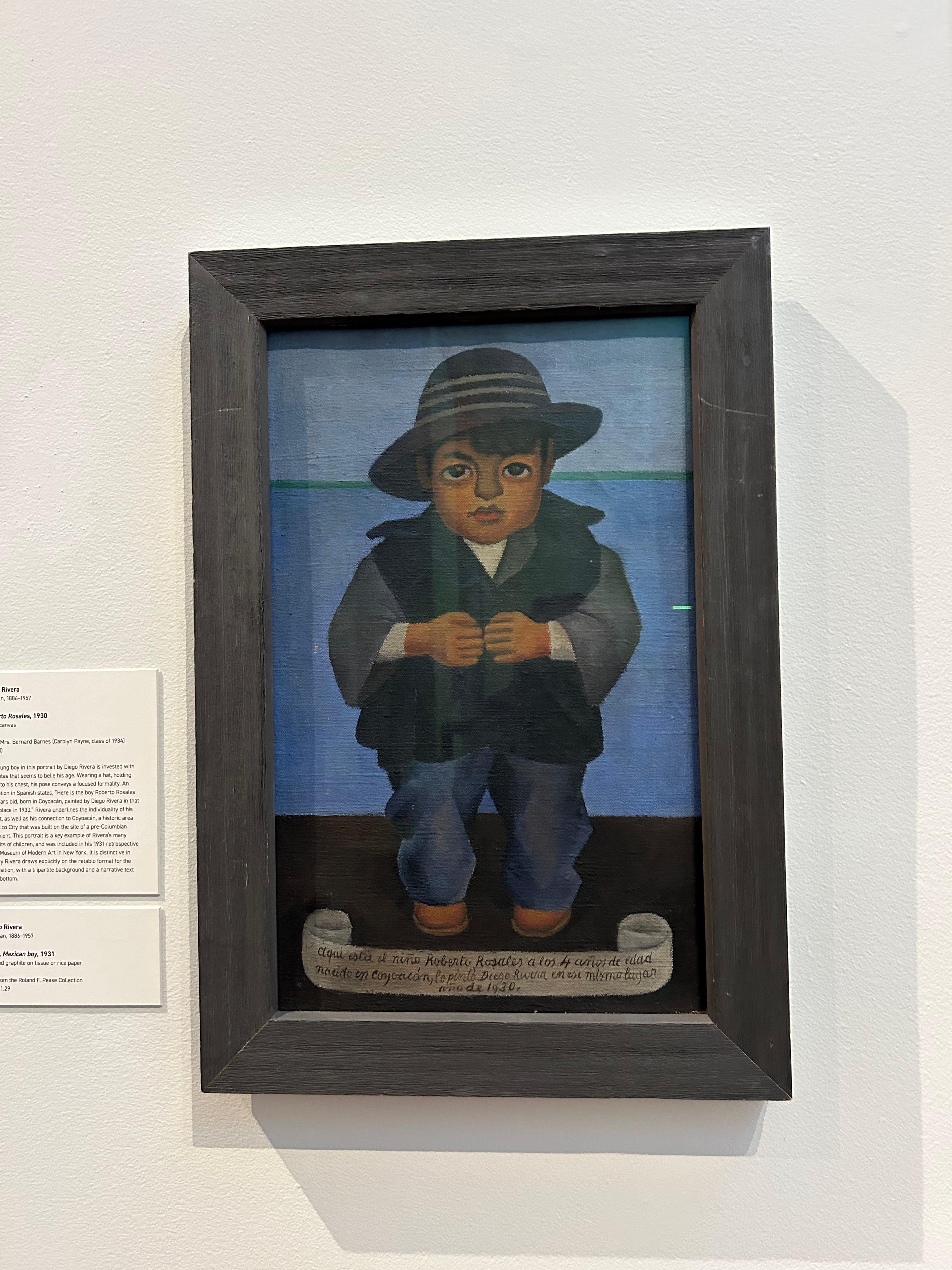
I paused when I noticed the piece by Mexican artist Diego Rivera (husband of the great Mexican artist Frida Kahlo), a portrait of a boy from Coyoacán named Roberto Rosales (1930), which gives the piece its title. This piece stands out for the way Rivera explicitly employs the altarpiece format in its composition. Amanda Porter, the associate director of learning and community engagement, noted that the permanent collection houses many artworks by Diego Rivera and other Hispanic artists, as well as pre-columbian artifacts. One of these artworks was loaned to the Detroit Institute of Arts. In exchange, the Loeb received on loan a magnificent work by Mark Rothko, a 20th-century abstract expressionist painter. This is a great luxury for the Hudson Valley community.
Amanda Porter also emphasized that what truly sets the Loeb apart from large museums is its community spirit. Here, you become part of a living ecosystem where some forty students actively work as docents, curatorial assistants, social media managers, art handlers, registrars, and archivists. Exhibitions rotate constantly in its three main galleries, ensuring there is always something new to see. For Porter, the collaborative work among students, staff, and art “allows the works to take root in the space with input from our students and ensures there is always renewed interest in pieces not recently viewed.”
The energy of Latin American art continues with the works of Rufino Tamayo. His Figura (de una mujer) (1939) and the lithograph Paysage Azteque (1950) remind us why the Mexican artist Tamayo is a master. His style projects a strength and pride that transcend the visual, connecting deeply with the roots and symbolism of indigenous peoples. Not far away, you’ll find the imposing work Los Fogoneros de la Tierra (1953) by the Chilean artist Roberto Matta, a painting so large and full of energy that it compels you to sit down for a moment to try to decipher the interaction of the characters in the depicted scene.
Another favorite is the Venezuelan-American artist Marisol, who in her work Sin título (1976) uses colored pencils on black paper, making the tones stand out with brilliance. Similarly, Juchiteca sentada (1975) by the Mexican artist Francisco Zúñiga stands out; with simple crayon strokes, he manages to capture all the strength of the Mexican woman.
There is also a work by the Catalan artist Joan Miró, titled “Pájaros, Personajes, y Estrella Azul” (1950). You can spend quite a while searching for the objects mentioned in the title, which are hidden among one another. Through his creativity, the artist captures our attention and keeps us focused on the shapes and colors.
Admission to the Loeb is completely free. The Center is open Tuesday through Sunday from 10 a.m. to 5 p.m. and on Thursday evenings during its special hours until 9 p.m. (September through May) or until 7 p.m. (June through August). If you’re looking to delve deeper into this cultural connection, mark your calendar for a Family Event on April 12 from 1 to 3 p.m., featuring activities for children ages 5 and up, at 124 Raymond Ave, Poughkeepsie.
The Loeb Center helps us connect with our heritage and lets our imaginations run wild without having to leave the Hudson Valley.
vassar.edu/theloeb/visit
back to top
COPYRIGHT 2026
La Voz, Cultura y noticias hispanas del Valle de Hudson
I paused when I noticed the piece by Mexican artist Diego Rivera (husband of the great Mexican artist Frida Kahlo), a portrait of a boy from Coyoacán named Roberto Rosales (1930), which gives the piece its title. This piece stands out for the way Rivera explicitly employs the altarpiece format in its composition. Amanda Porter, the associate director of learning and community engagement, noted that the permanent collection houses many artworks by Diego Rivera and other Hispanic artists, as well as pre-columbian artifacts. One of these artworks was loaned to the Detroit Institute of Arts. In exchange, the Loeb received on loan a magnificent work by Mark Rothko, a 20th-century abstract expressionist painter. This is a great luxury for the Hudson Valley community.
Amanda Porter also emphasized that what truly sets the Loeb apart from large museums is its community spirit. Here, you become part of a living ecosystem where some forty students actively work as docents, curatorial assistants, social media managers, art handlers, registrars, and archivists. Exhibitions rotate constantly in its three main galleries, ensuring there is always something new to see. For Porter, the collaborative work among students, staff, and art “allows the works to take root in the space with input from our students and ensures there is always renewed interest in pieces not recently viewed.”
The energy of Latin American art continues with the works of Rufino Tamayo. His Figura (de una mujer) (1939) and the lithograph Paysage Azteque (1950) remind us why the Mexican artist Tamayo is a master. His style projects a strength and pride that transcend the visual, connecting deeply with the roots and symbolism of indigenous peoples. Not far away, you’ll find the imposing work Los Fogoneros de la Tierra (1953) by the Chilean artist Roberto Matta, a painting so large and full of energy that it compels you to sit down for a moment to try to decipher the interaction of the characters in the depicted scene.
Another favorite is the Venezuelan-American artist Marisol, who in her work Sin título (1976) uses colored pencils on black paper, making the tones stand out with brilliance. Similarly, Juchiteca sentada (1975) by the Mexican artist Francisco Zúñiga stands out; with simple crayon strokes, he manages to capture all the strength of the Mexican woman.
There is also a work by the Catalan artist Joan Miró, titled “Pájaros, Personajes, y Estrella Azul” (1950). You can spend quite a while searching for the objects mentioned in the title, which are hidden among one another. Through his creativity, the artist captures our attention and keeps us focused on the shapes and colors.
Admission to the Loeb is completely free. The Center is open Tuesday through Sunday from 10 a.m. to 5 p.m. and on Thursday evenings during its special hours until 9 p.m. (September through May) or until 7 p.m. (June through August). If you’re looking to delve deeper into this cultural connection, mark your calendar for a Family Event on April 12 from 1 to 3 p.m., featuring activities for children ages 5 and up, at 124 Raymond Ave, Poughkeepsie.
The Loeb Center helps us connect with our heritage and lets our imaginations run wild without having to leave the Hudson Valley.
vassar.edu/theloeb/visit
back to top
COPYRIGHT 2026
La Voz, Cultura y noticias hispanas del Valle de Hudson
Comments | |
| Sorry, there are no comments at this time. |