The exhibition Esa
otra mitad del cielo: Feminist Strategies in Post-1968 Mexican Art, presented at the Bard Hessel Museum of Art, brought together by the collective
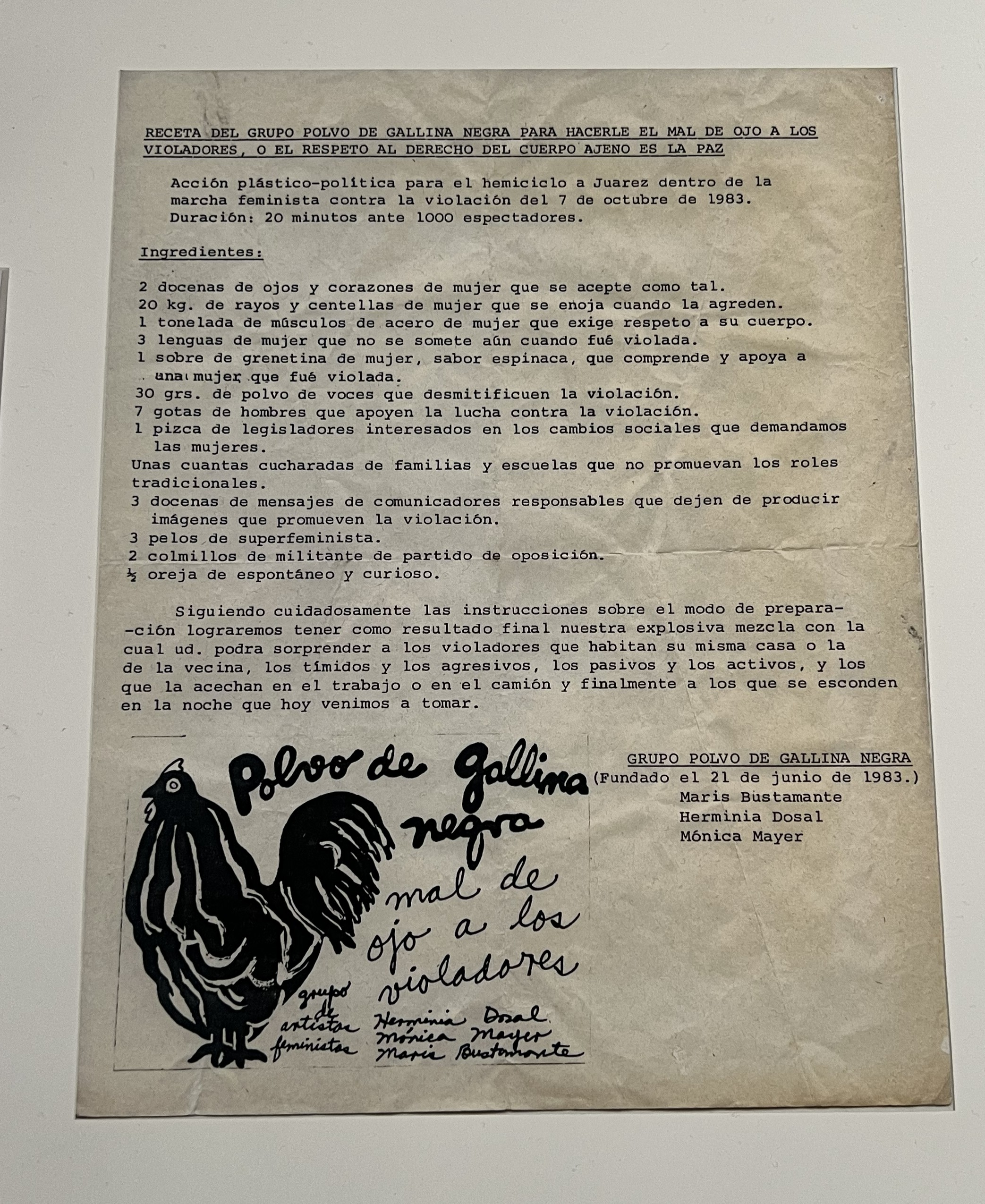
Polvo de Gallina Negra, that utilizes humor, satire comedy, and acting/performance as political tools. Among their works, one piece stands out: a television host is invited to wear a fake pregnancy belly and to experience what it means to inhabit a body historically and socially associated with women.
This real life work of art was created by the Mexican feminist collective
Polvo de Gallina Negra, which was founded in the 1980s by the artists Mónica Mayer and Maria Bustamante. Their objective was clear: question toxic masculinity through absurdity and with artistic means, obligating the public to literally put themselves “on the other side.”
In the video presented at the exhibition, the artists of
Polvo de Gallina Negra ask presenter Guillermo Ochoa to put on a fake pregnancy belly. At first, he uses jokes and teasing to mask his discomfort and engage the audience. However, as the interview progresses, his attitude changes. He asks the group if what’s occurring is supposed to be a work of art. They show him how the male body, which is accustomed to observing motherhood from the outside, now has to participate in it from within. At one point, he starts complaining that he doesn’t want to do anything in his current state of pregnancy, and they tell him: “So it seems that you’re finally starting to understand from the other side how things are... You’re entering our world.”
In an interview with La Voz, artist Mónica Mayer explained that this intervention was only possible because Ochoa fully agreed to participate. “It was with a host like him, willing to play along, that this could be done.” The program had enormous reach: it was broadcast in millions of homes and transformed a feminist action into a public conversation. But the impact didn’t end that day. Mayer shared that, for an entire year, Ochoa was mocked for wearing the fake belly. As an example, nine months later, someone in the audience asked Guillermo Ochoa if he had had a girl or a boy. That seemingly trivial gesture marked a profound change. Years later, Ochoa himself recognized the action as a work of art, which at the time he hadn’t been able to understand, but years later he was able to grasp what the artists were trying to do.
This role reversal connects directly with contemporary actions like “Walk a Mile in Her Shoes,” an international fundraising event where men walk a mile in high heels to raise awareness of gender violence and the inequalities women face. In both cases, the message is similar: empathy doesn’t just simply arise solely from words, but from the body. To understand, one must feel.
Polvo de Gallina Negra understood this decades before. In inviting men to “convert themselves” symbolically into women, the artists didn’t just look to ridiculize, if not provide evidence and highlight how contrary and arbitrary the unequal gender roles are. Humor in this case, worked as a feminist strategy to disarm defenses, expose contradictory stereotypes, and open spaces for reflection.
back to top
COPYRIGHT 2026
La Voz, Cultura y noticias hispanas del Valle de Hudson